· ReadyStack
Worked example
Real numbers from this tool, line by line.
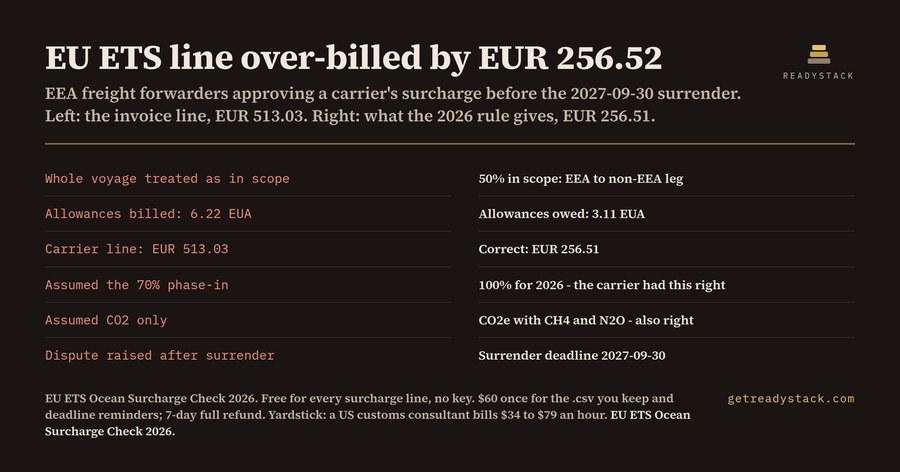
A freight forwarder in Rotterdam approved an EU ETS surcharge of EUR 513.03 on one container that owed EUR 256.51.
Nothing looked wrong. The carrier named the emission year, quoted an EUA price, printed a figure. What it did not print was the scope factor, and that is where the money was. The box came from a non-EEA port, and on a voyage into or out of the EEA only 50% of the emissions fall inside the system. The line was built as if all of it counted. Doubling 3.11 allowances to 6.22 is invisible in a total.
Three numbers have to be right at the same time on that line, and two of them changed on 1 January 2026.
The first is the phase-in. Shipping companies surrendered allowances for 40% of the emissions reported in 2024, then 70% of those reported in 2025. From 2026 emissions it is complete at 100%. An invoice still resting on the 70% basis is billing last year's rule, and a forwarder checking it against memory will nod it through.
The second is the scope factor, which moves with the voyage, not the calendar. Emissions are 100% in scope between two EEA ports and while at berth in an EEA port. They are 50% in scope on a voyage into or out of the EEA from or to a non-EEA port. Two legs of the same service, two answers, one identical-looking line.
The third is which gases count. Until the end of 2025 the maritime obligation was CO2 only. On 1 January 2026 methane and nitrous oxide entered it, counted as CO2e. On an LNG dual-fuel ship that is not a rounding difference. Run the same Shanghai-Rotterdam box as a 2025 emission and the answer is 2.03 allowances and EUR 150.30; as a 2026 emission it is 3.11 allowances and EUR 256.51.
This is the kind of question a chatbot answers confidently and wrongly. Ask one what a 2026 surcharge should be and it reaches for the 70% phase-in and the CO2-only basis that dominated its training data, true for two years and false since January. Nor can it see your voyage leg, the one input deciding whether you owe half or all of it.
The arithmetic itself is four multiplications per line, each needing a rule you have to look up, across hundreds of lines a month. So the check was built as a browser extension. You type 7 fields off the carrier's ETS statement and the invoice: emission year, voyage leg, CO2 tonnes, CH4 and N2O tonnes as CO2e, the EUA price used, the amount billed, and the surrender deadline. It returns the allowances owed, the correct surcharge, the difference in euro and percent, the gases in scope, and the deadline. On the Rotterdam box it returns: over-billed by EUR 256.52, 100% above the allowances owed. That sentence is the dispute email.
Allowances for a year's emissions are surrendered by 30 September of the following year - for 2026 emissions, 30 September 2027. A correction raised before that date is an adjustment; raised after, it is a negotiation.
A checker that only finds money in your favour is not a checker. Hamburg to Gothenburg, 1.9 tonnes, no methane, billed EUR 120.00: both ports are in the EEA, the whole voyage is in scope, and the correct figure is EUR 156.71. That line is under-billed by EUR 36.71, and a correction invoice is coming.
The calculation is free - no key, no limit, nothing watermarked - in the popup and on a web page running the same code. The paid version works on a different axis: it keeps checked lines as .csv rows and sets reminders 30, 14 and 1 days before the surrender deadline.
A US customs consultant bills $34 to $79 an hour, and independent trade-compliance firms charge $150 to $400 an hour - and they take portfolios, not single lines.
15 seconds — what it actually does
Full walk-through
Questions people ask
What does the EU ETS Ocean Surcharge Check actually do?
It re-runs the ETS surcharge line on an ocean freight invoice. You type the emission year, the voyage leg, the CO2 and CH4+N2O tonnes allocated to your shipment, the EUA price and the amount billed. It returns the allowances actually owed, the correct euro figure, and the gap between that and the invoice.
Who is this for?
Freight forwarders, import cost controllers and shippers moving containers into or out of the EEA who receive an ETS or EUA surcharge line from the carrier. It is for the person who has to approve that line, not for the shipping company that reports emissions and surrenders the allowances.
Why will a chatbot not answer this correctly?
Because the rule changed on 1 January 2026 in two places at once. The surrender obligation went from 70% of 2025 emissions to 100% of 2026 emissions, and methane and nitrous oxide entered the system as CO2e. A model trained earlier answers with 70% and CO2 only, and it cannot see which voyage leg you shipped on.
What is free and what does the full version add?
Free covers the whole calculation: 7 typed fields, all 5 checks, unlimited invoice lines, in the popup and on the web page, with no key. The full version at $60 adds a different axis, not more answers - it saves each checked line as a .csv row you keep, and sets reminders 30, 14 and 1 days before the surrender deadline.
What would it cost to have a person check these lines?
A US customs consultant bills $34 to $79 an hour and independent trade-compliance firms charge $150 to $400 an hour, and they normally take a whole freight portfolio rather than a single surcharge line. Ocean post-audit firms work on gainshare, keeping a share of whatever they recover for you.
Ask about this tool
One question, answered by the person who built it. Your email only if you want the answer sent.